





Biblical Reflection: “To the Least of These”


Biblical Reflection: “To the Least of These”
Mathew 25:31-46, Romans 12:2
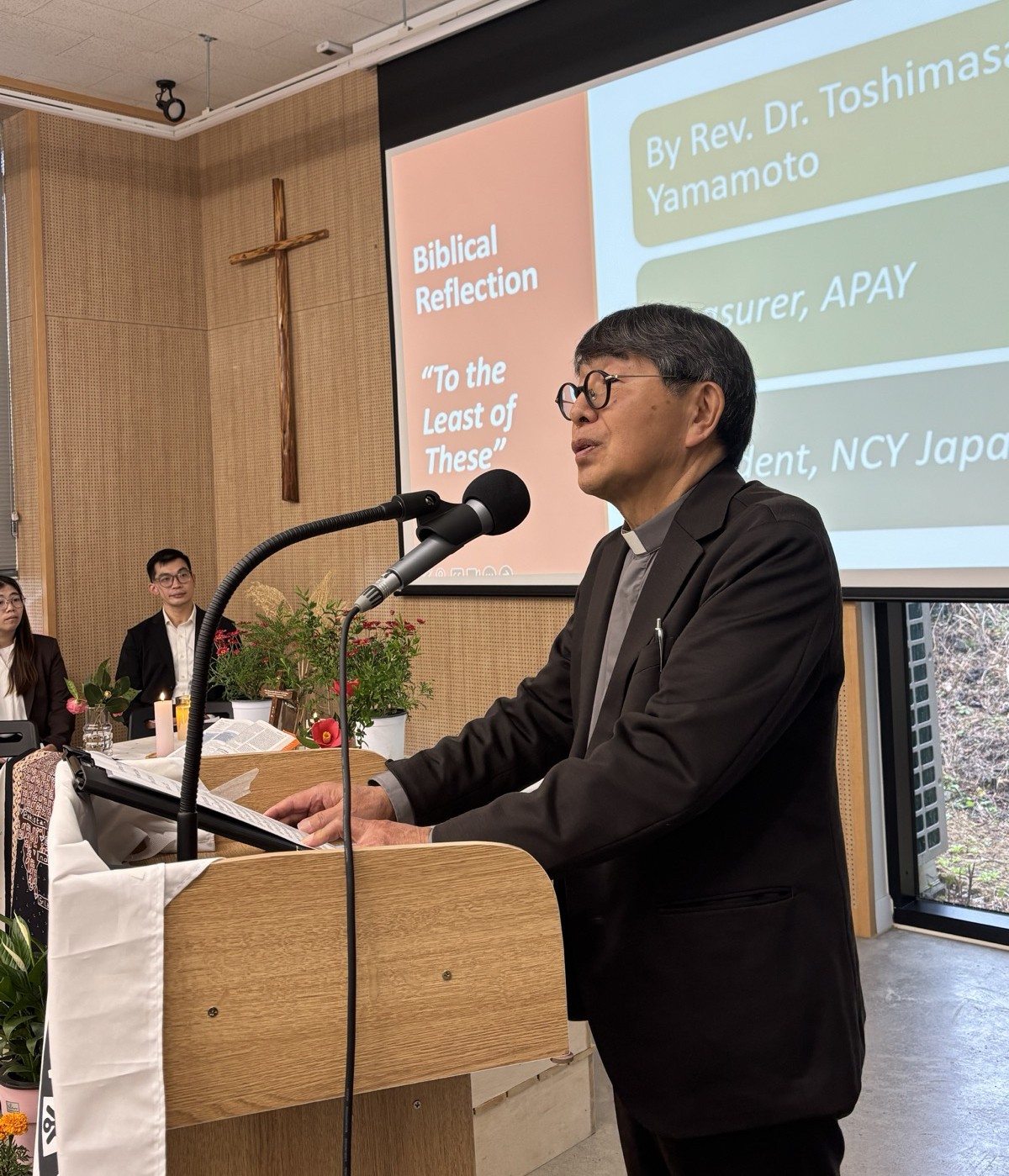
By Rev. Dr. Thoshimasa Yamamoto
Good morning.
Although I have been involved with YMCA for more than 40 years, since most of you don’t know me that well, let me, first of all, share with you, as a part of introduction, about my faith journey, how I became a Christian and why I got involved with YMCA. I was born and raised in Tokyo and grew up in a Buddhist family. Although my parents were not overly dedicated Buddhists, there was a Buddhist altar at home, and they would go to temples on special holidays. Buddhist culture and Buddhist spirituality were a very important part of my upbringing.
My first encounter with Christianity occurred when I was in high school. One day, my good friend took me to his church. It was not a so-called mainline Church. In fact, it was much more conservative than most mainline Protestant Churches. Nevertheless, I really enjoyed myself being there. People were very nice and friendly. The pastor was a missionary from the United States. He spoke very good Japanese, although with a Southern accent.
After three months had passed, he asked me whether or not I had thought about being baptized. I said, " No, I had not yet thought about it”. And then he explained to me about the meaning of baptism, which was very good and helpful. During the conversation, he also asked me whether or not my parents were Christian. I said "No, they are not Christian, they are Buddhist.“ Then he said, "Yamamoto-san, that's not really good. They might go to hell."
It was such a shocking statement to me at that time. I said to myself, so if I were baptized and went to heaven, then my parents, who loved me so much, would go to hell. I thought something must be wrong with this logic. At least it is not fair. I strongly felt at that time that Christianity was very exclusive. And so, I decided to stay away from church for several years. Later, I had another opportunity to encounter Christianity after I went to Indonesia for one year.
From 1972, I spent a year in Indonesia as an exchange student through the International Christian Youth Exchange (ICYE) program, which was administered by the National Christian Council in Japan (NCC), and later the program was transferred to the Tokyo YMCA. ICYE was not an academic exchange program; rather, it aimed to promote peace and reconciliation through youth exchange. During that time, I stayed at the home of an Indonesian Presbyterian minister. He was very different from the missionary whom I had met in Tokyo. He did not ask me to read a Bible or to pray; he didn't even ask me to go to his church on Sunday, which I thought was a little bit strange, but he didn't push me to do anything church-related. He was also involved with the YMCA in Jakarta as a board member.
As I grew closer to him and to my host family, I became increasingly impressed by his simple lifestyle, sincere faith, and strong commitment to social justice and peace issues. He was working hard with the poor and homeless in Jakarta’s downtown area. I also realized that what kept him going was deeply rooted in his Christian faith. Precisely because of this realisation, I began to read the Bible again, and after returning to Tokyo, I attended church. To make a long story short, I was later baptized in Tokyo. So, this particular Indonesian minister taught me, without saying a word, that when we care for the least important brothers and sisters among us, we do so as if we were caring for Jesus.
Today's Matthew text is about the last judgment. This is the only detailed description which the New Testament gives us about the last judgment, which is very different from the conventional scenario of the last judgment. If you are not Christian, you go to hell, and if you are Christian, you go to heaven. This is not the case, as long as this text is concerned. This text tells us that at the last judgment scene, we are divided into two groups, the goat group and the sheep group. The sheep group goes on to eternal life, but the goat group goes on to eternal fire. Those who responded to basic human needs for others belong to the sheep group, and those who did not respond belong to the goat group.
Jesus offers a handy checklist to which group we belong. He said, “When I was hungry, you gave me food, and when I was thirsty, you gave me a drink.” To our big surprise, when both the sheep and goats heard this checklist, both groups were somehow puzzled and bewildered. They thought that there must have been some mistake. They said to each other, when did we ever see Jesus hungry, thirsty, sick and so forth?
We have never seen Jesus that way. Neither the sheep nor the goats understood what Jesus was talking about. They received the same answer from Jesus, though for goats it was negative. He said, “Truly, truly I say to you, whenever you did this for one of the least important brothers and sisters of mine, you did it for me.” What Jesus was talking about here was to say that when we support the hungry, we are not only supporting the hungry but we are glorifying God. And when we reject the hungry, we are not only rejecting the hungry, but we are rejecting God. This is not at all new in the Bible. As you may know, Paul emphasizes, “you shall love your neighbour as yourself “in the book of Galatians. The Book of James repeatedly tells us, “our faith, if it has no works, is dead.” Despite all these teachings for more than 2000 years, we still cannot love our neighbours. When we look at this world today, hundreds of millions of dollars are spent on waging war, while more than 700 million people are suffering from acute hunger and severe malnutrition. This occurs even though there is sufficient food to feed them and enough land to raise the necessary crops. Unnecessary suffering and death are confronting us. Maybe we love ourselves too much. Mother Teresa once said that “we all know how much God loves us, but we don't know how we can love God.” As far as she is concerned, the only way she can love God is to love her neighbours. That is why she worked and stayed with the poorest of the poor in Calcutta, India, as a missionary.
Another big surprise for me in this text was the fact that Jesus called himself “ King “ twice in verses 34 and 40. I don't know about your image of Jesus and king, but my image of Jesus is not like a king. Frankly speaking, I do not personally know any kings in this world, including the Japanese emperor. I don't particularly feel close to them. I have never been invited to have lunch with them-- I do respect them to some extent as a symbol of their country, but I have never been inspired by their country. Probably the only king that I am familiar with is a well-known Fast-Food Chain restaurant, called "Burger King"! Besides Burger King, there is also the Disney movie and play, “Lion King”, which my sons used to enjoy watching the video when they were children.
Anyhow, Jesus was not so much like a king as he was the one who washed his disciples' feet. And, according to the Gospel of John, Jesus withdrew from a crowd that intended to make him an earthly king by force.
Like the German theologian, Dietrich Bonhoeffer, I see Jesus and God as co-sufferers with humans. And this image of Jesus eliminates the view that God is acting in human history in a controlling way. Rather, God enters this world as a human and suffers with us. “Emmanuel,” meaning God is with us. Jesus is perceived as powerless and ineffective, yet paradoxically, utter powerlessness brings about a profound love. The image of the crucified Christ, being so weak and vulnerable, can become a source of power and strength for our lives. It is clear in this text that Jesus was a king who identified himself with those who are hungry, thirsty, naked, sick, and poor.
Romans 12:2 says, "Do not conform to the pattern of this world but be transformed by the renewing of your mind."
As we all know, the "pattern of this world" is marked by division, injustice, and violence, and we YMCA are called to transform the world through renewed minds. We also know that the YMCA was founded on the conviction that faith is not private but lived out in community. Faith calls us to see every person as created in God’s image, deserving dignity and respect. The YMCA’s mission today includes advocacy for marginalized communities, promoting gender equity, and fostering reconciliation in divided societies. I firmly believe that YMCA initiative will bring together young people from different religious backgrounds to build trust and collaborate on community projects.
Romans 12:2 clearly reminds us that transformation begins within and how we can relate and follow Jesus.
Going back to today's Matthew text, Matthew clearly reminds us that it is our relationship with God that counts, whether we belong to the goat group or the sheep group. When we feed the hungry, give drink to the thirsty or when we reject these basic needs, we are expressing our relationship or our lack of relationship with God. Likewise, when the YMCA stops outreaching beyond its membership, stops working for Pace and Justice, and it's caught up with profit making business model mentality and its maintenance program, that is exactly when Jesus strongly questions us and reminds us, saying, " Truly, truly, I say to you, whenever you did this to the one of the least important brothers and sisters of mine, you did it to me.
Let us pray.
Loving and compassionate God,
You who come to us in the hungry, the thirsty, the stranger, and the suffering,
open our eyes to see Your presence in all people.
Guide us, as individuals and as a community,
to walk in the way of Christ,
seeking justice, sharing peace, and caring for those most in need.
Transform our hearts,
that we may not simply hear Your Word, but live it?
serving others with humility, courage, and love.
In Your holy name we pray.
Amen.
------------------------------------------------------------------------------------------------------------------
Rev. Dr. Thoshimasa Yamamoto is a Japanese Christian leader, educator, and
peace activist. He currently serves as the Treasurer of the Asia & Pacific
Alliance of YMCAs, President of the YMCA of Japan and is also the Chairperson of
the Board at the Asian Rural Institute. This Biblical reflection was presented at the
Executive Committee Meeting of the APAY held during April 17-19, 2026, Jeju, South Korea.