






Gender Justice, Climate Justice: Building Inclusive and Sustainable Futures


Last Updated (Friday, 23 October 2026 16:03)
Asia and Pacific Alliance of YMCAs Regional Gender Justice Program 2026
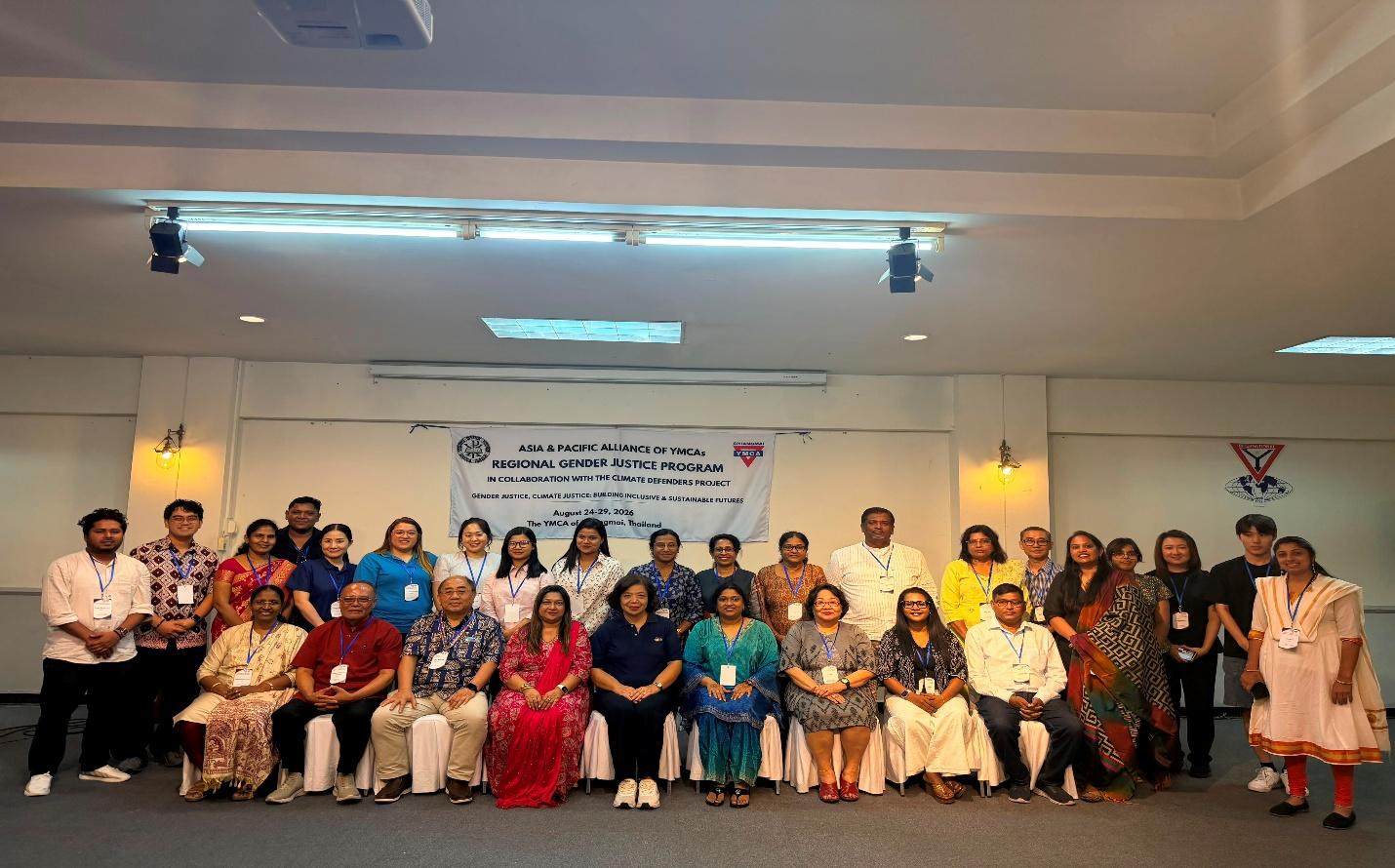
Participants of the Regional Gender Justice Program 2026
Program dates: August 24-29, 2026, Chiang Mai, Thailand
Communique
“Gender Justice, Climate Justice: Building Inclusive and Sustainable Futures”
The Regional Gender Justice Program 2026, organized in collaboration with the Climate Defenders Project, was held from August 24–29, 2026, as a major initiative of the Asia and Pacific Alliance of YMCAs (APAY). Hosted by the YMCA of Chiang Mai, Thailand, the program gathered 27 participants and staff members from eight countries—Bangladesh, Hong Kong, India, Indonesia, Korea, Myanmar, the Philippines, and Thailand—to explore the critical intersection of gender justice and climate action.
The program began with worship affirming that all people are created in God’s image and share the responsibility of caring for creation. Guided by the theme “Gender Justice, Climate Justice: Building Inclusive and Sustainable Futures,” participants engaged in worship, biblical reflections, country sharing, community exposure visits, policy dialogues, and action-planning sessions.
Discussions focused on empowering youth, advancing gender equity for a sustainable future, addressing intersecting inequalities, and developing gender-responsive climate policies. A roadmap for YMCA climate justice was also presented. Country experiences highlighted how climate change disproportionately affects women and marginalized gender communities across the Asia-Pacific region. Biblical reflections on caring for our common home and embracing God’s inclusive mission deepened understanding of the inseparable relationship between faith, gender justice, and environmental stewardship.
Group discussions provided space for participants to share experiences and reflections on climate change and women’s resilience. Participants explored key priority areas: breaking barriers to empower women’s rights and voices, ensuring equitable climate solutions by involving women and diverse genders in leadership and resource planning, and guaranteeing meaningful representation of women and marginalized genders in climate actions and policies. These exchanges emphasized the importance of recognizing women’s leadership and voices in building resilient and inclusive communities.
A panel of speakers offered valuable insights on climate and gender justice from diverse perspectives. They highlighted the role of interfaith collaboration, emphasized women’s leadership in the climate movement, and examined how the climate crisis is intertwined with patriarchy and capitalism. The panel also presented concrete guidelines for adopting low‑carbon lifestyles and shared best practices from YMCAs in responding to the climate emergency.
Exposure visits to the Environment and Energy Learning Center of Sao Hin YMCA and environmentally significant sites in Chiang Mai demonstrated practical approaches to stewardship, carbon neutrality, and sustainable living. These experiences reinforced the importance of local initiatives and community-based solutions in addressing global climate challenges.
The program emphasized the Christian calling to care for creation and uphold justice, equality, and dignity, while building inclusive communities where women, youth, and marginalized genders are recognized as leaders and agents of change. Participants committed to advancing climate justice through gender-responsive and rights-based approaches and strengthening regional solidarity among YMCAs in responding to social and environmental challenges.
Affirmation and Key recognitions
Key recognitions included the acknowledgment that climate change intensifies social, economic, and gender inequalities, disproportionately affecting women, girls, Indigenous peoples, and marginalized gender communities. Sustainable and climate-resilient development requires the meaningful participation of all genders in decision-making processes, while youth play a critical role in shaping innovative, community-driven solutions. Faith communities were recognized as having a vital responsibility to advocate for justice, peace, and sustainability.
Recommendations
Recommendations were made at multiple levels.
APAY leadership was urged to integrate gender and climate justice into strategic priorities, support regional learning exchanges, encourage greater participation of women and youth in governance, and develop tools to help National Movements mainstream gender and climate justice.
National Movements were encouraged to adopt gender-responsive approaches in climate action, disaster preparedness, and community development, promote youth leadership in environmental advocacy, build partnerships with civil society and government agencies, and allocate resources to address vulnerabilities faced by women and marginalized communities.
Local YMCAs were advised to implement sustainable practices, contribute to carbon reduction, develop community-based resilience initiatives, create inclusive spaces for women and youth in leadership, and conduct educational programs on climate justice and sustainable living.
Advocacy efforts should focus on promoting gender-responsive climate policies, recognizing climate justice as a human rights issue, amplifying the voices of women and marginalized communities, and encouraging faith communities to engage actively in stewardship.
Faith-based advocacy should affirm human dignity, promote environmental responsibility, embrace God’s inclusive mission, respond to injustices with compassion and solidarity, and foster harmony between people and creation.
Participants committed to developing and implementing gender-responsive climate action plans within their YMCAs and communities, strengthening education and awareness programs, supporting youth-led initiatives, promoting inclusive leadership, sharing good practices across the APAY network, and monitoring progress to advance gender and climate justice.
Looking ahead to 2030, the vision is of an Asia-Pacific YMCA movement where gender equality and climate justice are fully integrated into policies, programs, and organizational culture. Women, youth, and marginalized genders will participate equally in leadership and decision-making at all levels. YMCAs will serve as models of environmental sustainability and stewardship, communities will be more resilient to climate impacts, and strong regional partnerships will foster collective action toward achieving the Sustainable Development Goals, particularly SDG 5 on gender equality, SDG 13 on climate action, and SDG 17 on partnerships.
The communique concludes with a call to action, affirming that gender justice and climate justice are inseparable. Building sustainable futures requires confronting inequalities that make communities vulnerable while promoting inclusive solutions that empower all people.
Participants return to their communities inspired to transform learning into action and call upon YMCAs, faith communities, governments, civil society organizations, and all people of goodwill to work together in advancing justice, equality, sustainability, and peace.
Together, they commit to building inclusive and sustainable futures where no one is left behind and creation is cared for with responsibility, compassion, and hope.
Issued by the Participants of the APAY Regional Gender Justice Program 2026
Chiang Mai, Thailand 28 August 2026